Master Your Home Practice with a Solid 60 Minute Vinyasa Flow Plan
Core Principles of Sequencing an Effective Flow
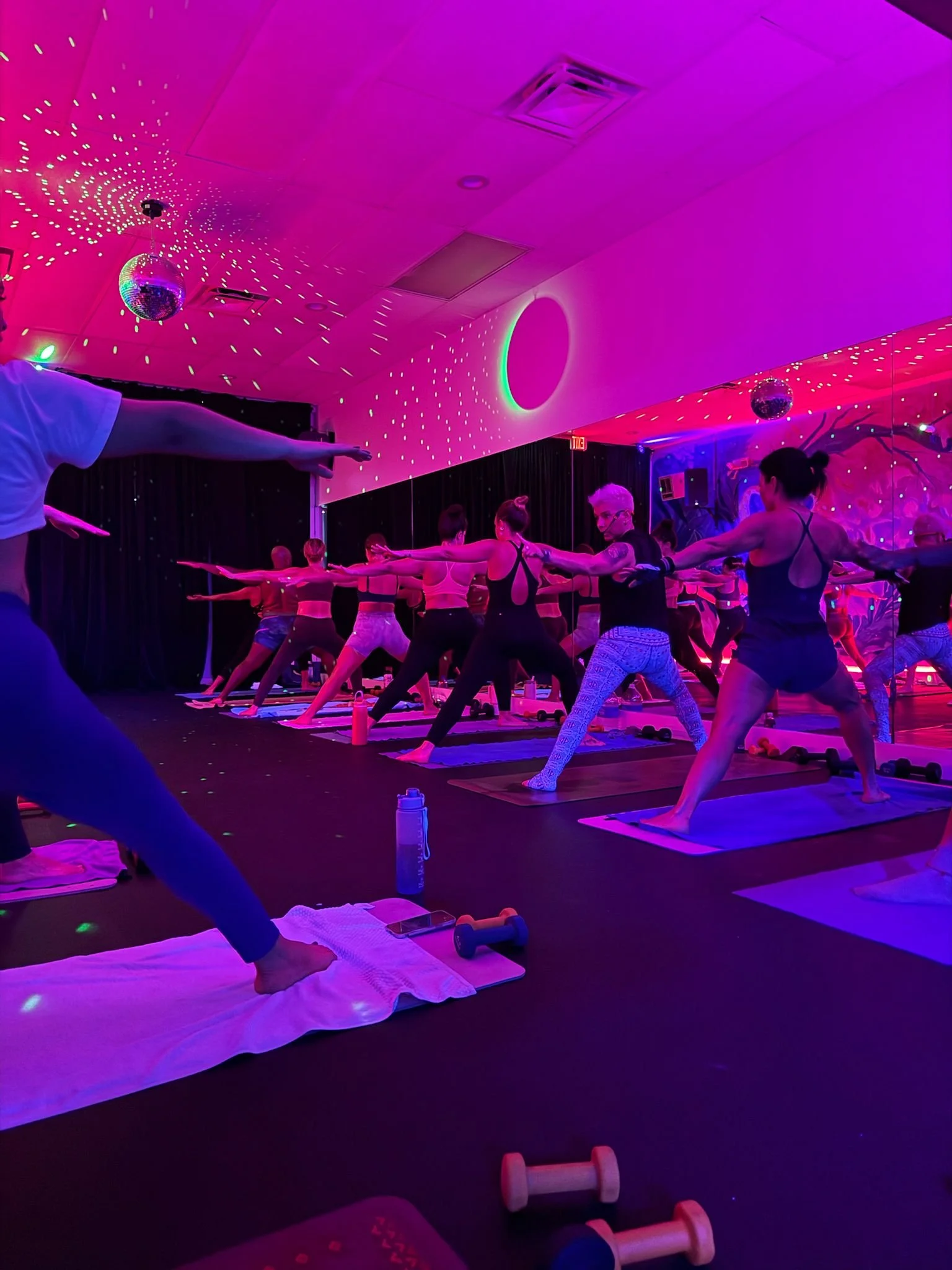
A solid 60 minute vinyasa flow follows a balanced six-phase arc: 5 minutes of centering and breathwork, 7 minutes of gentle warm-up, 10 minutes of sun salutations for heat building, 18 minutes of standing flows, 6 minutes of peak pose exploration, and 14 minutes divided between floor cool-downs and restorative Savasana. Structuring your home practice around this progression ensures seamless transitions, steady cardiovascular pacing, and balanced mobility without overloading joints.
Sequencing an intelligent flow requires an understanding of biomechanics, energetic pacing, and somatic continuity. In any standard hour-long sequence, a practitioner moves through roughly 30 to 50 pose positions once both sides, transitional flows, and repetitions are accounted for. When examining the underlying biomechanics of a well-rounded class, stretch-focused postures make up around 68% of the movements, forward bends account for 27%, and balance postures represent roughly 23%.
Data shows that the lower back is engaged in approximately 72% to 78% of the postures in a standard sequence, with the gluteus (75%) and hamstrings (72%) closely following. Because these muscle groups carry the physical workload of the class, our transitions must prepare them progressively rather than shocking them with sudden, deep end-range demands.
Energetically, a balanced sequence activates foundational energy centers: studies on sequencing patterns show that the root chakra (Muladhara) and sacral chakra (Svadhisthana) are activated in up to 59% of postures, establishing physical stability and emotional fluidity. Whether you are leading a room or rolling out your mat at home, your unique teaching voice should guide the experience. Authenticity matters far more than novelty—moving "slow, like honey" creates spaciousness that rigid, hyper-choreographed sequences often miss.
Structuring the Peak Pose Arc in a 60 Minute Vinyasa Flow
To build toward a focal posture safely, we use reverse-engineering. Instead of choosing postures randomly, select your peak pose first—such as Half Moon Pose (Ardha Chandrasana) or an intermediate arm balance—and deconstruct its anatomical requirements.
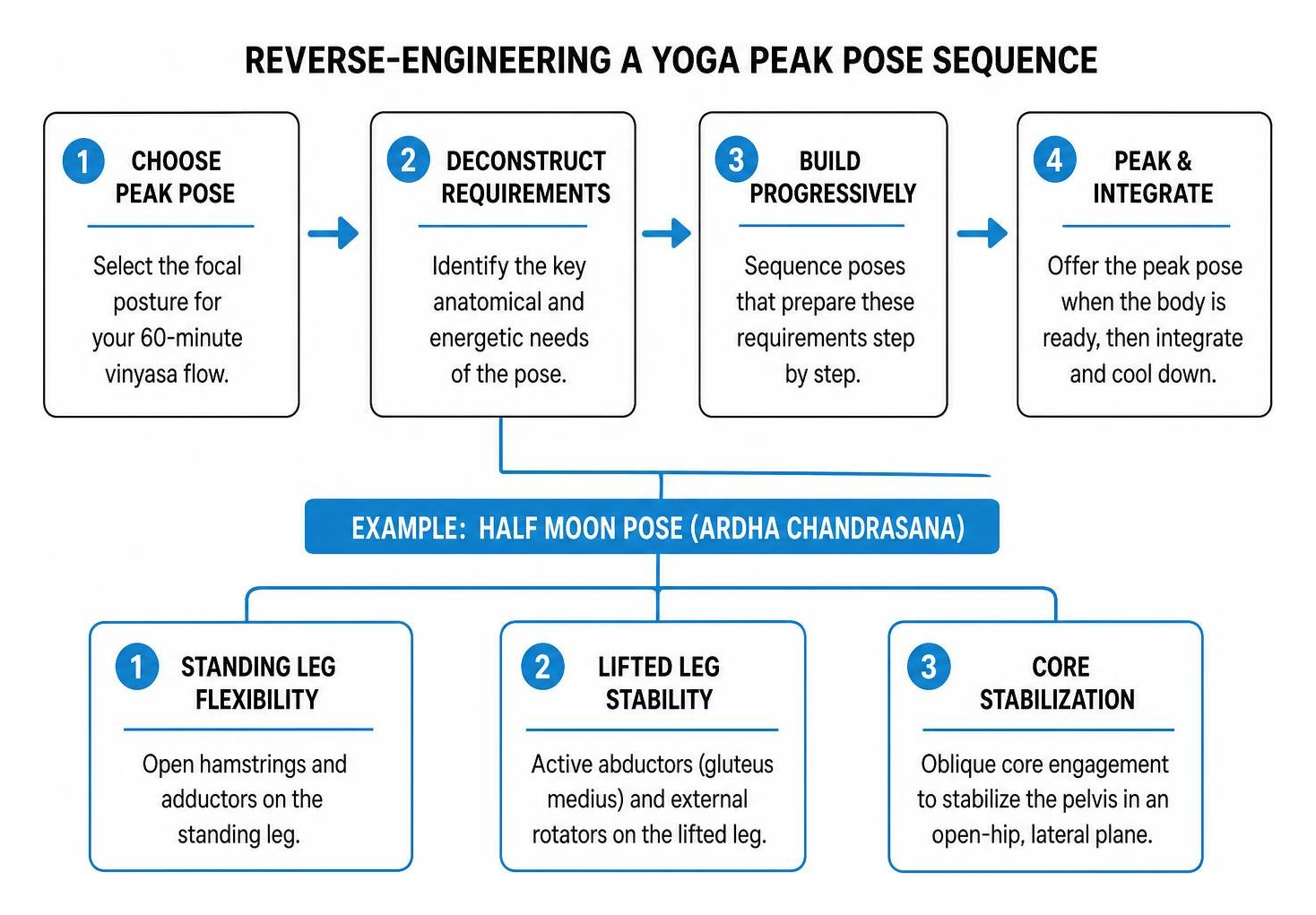
When preparing for Half Moon, for example, the body requires three key components:
- Open hamstrings and adductors on the standing leg.
- Active abductors (gluteus medius) and external rotators on the lifted leg.
- Oblique core engagement to stabilize the pelvis in an open-hip, lateral plane.
By referencing a structured guide to yoga pose sequences, we can layer these foundational actions into earlier, less demanding postures. Low lunges open the hip flexors, Extended Side Angle activates the lateral chain, and Warrior III introduces single-leg weight bearing. By the time the peak arrives around minute 40, the nervous system recognizes the component shapes, drastically reducing the risk of strain.
Incorporating Arm Balances, Inversions, and Playful Transitions
Playful elements like Crow Pose (Bakasana), side planks, or handstand hops inject vitality into your practice. However, complex postures require progressive loading. Wrist joints and shoulder stabilizers need targeted preparation before bearing full body weight.
Begin with table-top wrist stretches and downward dog shoulder protraction during the warm-up. Introduce core compression drills—such as transitioning between High Boat and Low Boat (Navasana to Ardha Navasana)—during the heat-building phase. When introducing Crow Pose, frame it as a natural progression from a deep yogic squat (Malasana), giving yourself permission to lift one toe at a time. For those looking to master sequencing methodology and biomechanics on a deeper level, exploring dedicated teacher training provides the anatomical foundation needed to teach and practice these advanced transitions safely.
The Minute-by-Minute Architecture of a 60 Minute Vinyasa Flow
Pacing is the backbone of an effective yoga class. Without a clear timeline, it is easy to spend twenty minutes warming up and find yourself rushing through seated postures or shortchanging rest. A structured breakdown ensures every phase receives adequate attention while honoring the natural physiological curve of the body.
| Class Phase | Time Window | Target Heart Rate / State | Primary Focus & Postures |
|---|---|---|---|
| 1. Centering & Arrival | 00:00 – 05:00 | Resting (60–75 bpm) | Child's Pose, diaphragmatic breath, spinal articulation |
| 2. Gentle Warm-Up | 05:00 – 12:00 | Light Warm-Up (80–100 bpm) | Cat-Cow, Downward Dog, gentle forward folds, low lunges |
| 3. Heat Building (Surya A & B) | 12:00 – 22:00 | Moderate Aerobic (100–125 bpm) | Sun Salutations A & B, Chair Pose, Crescent Lunge |
| 4. Standing Flow & Balances | 22:00 – 40:00 | Target Aerobic (120–145 bpm) | Warrior II, Triangle, Side Angle, Tree, Warrior III |
| 5. Peak Exploration | 40:00 – 46:00 | Peak Focus (110–135 bpm) | Half Moon, Crow Pose, or targeted peak variations |
| 6. Cool-Down & Floor Work | 46:00 – 54:00 | Recovery / Parasympathetic | Pigeon Pose, Seated Forward Fold, Supine Twists |
| 7. Final Rest (Savasana) | 54:00 – 60:00 | Deep Rest (<70 bpm) | Complete physical stillness, nervous system integration |
For a broader perspective on structuring your time, consulting a comprehensive vinyasa class guide can help reinforce how individual components merge into a cohesive 60-minute framework.
Phase 1 to 3: Centering, Sun Salutations, and Heat Building (Minutes 0–22)
The opening third of class establishes breath rhythm and internal body temperature (tapas). Begin in an extended Child's Pose (Balasana) or a comfortable seated position, dedicating five full minutes to intentional pranayama. Establish an even Ujjayi breath—inhaling and exhaling through the nose with a slight constriction at the back of the throat.
Transition through tabletop to explore Cat-Cow (Marjaryasana-Bitilasana), mobilizing the spine in flexion and extension while waking up the paraspinal muscles. By minute 8, press into Downward-Facing Dog (Adho Mukha Svanasana).
Move through three rounds of Surya Namaskar A to warm the major joint complexes, linking one breath to each movement. Follow with two to three rounds of Surya Namaskar B, incorporating Chair Pose (Utkatasana) and Warrior I (Virabhadrasana I). Integrate sweeping chair variations and dynamic crescent lunges to fire the glutes, hamstrings, and lower back, bringing the cardiovascular system into an active training zone.
Phase 4 to 6: Standing Flow, Peak Exploration, and Cool-Down (Minutes 22–60)
The standing flow (minutes 22 to 40) is the creative core of the practice. Move fluidly between standing postures that rotate the hips through both closed and open orientations:
- Flow A (Closed Hip): High Crescent Lunge $\rightarrow$ Revolved Side Angle $\rightarrow$ Warrior III.
- Flow B (Open Hip): Warrior II $\rightarrow$ Extended Side Angle $\rightarrow$ Reverse Warrior $\rightarrow$ Triangle Pose (Trikonasana).
Around minute 40, enter your peak pose window. Because roughly 81% to 93% of a sustainable vinyasa class consists of beginner-friendly foundations, the peak serves as an invitation, not a test. Spend 5 to 6 minutes exploring the apex posture—such as balancing Half Moon or Crow Pose—offering props and variations.
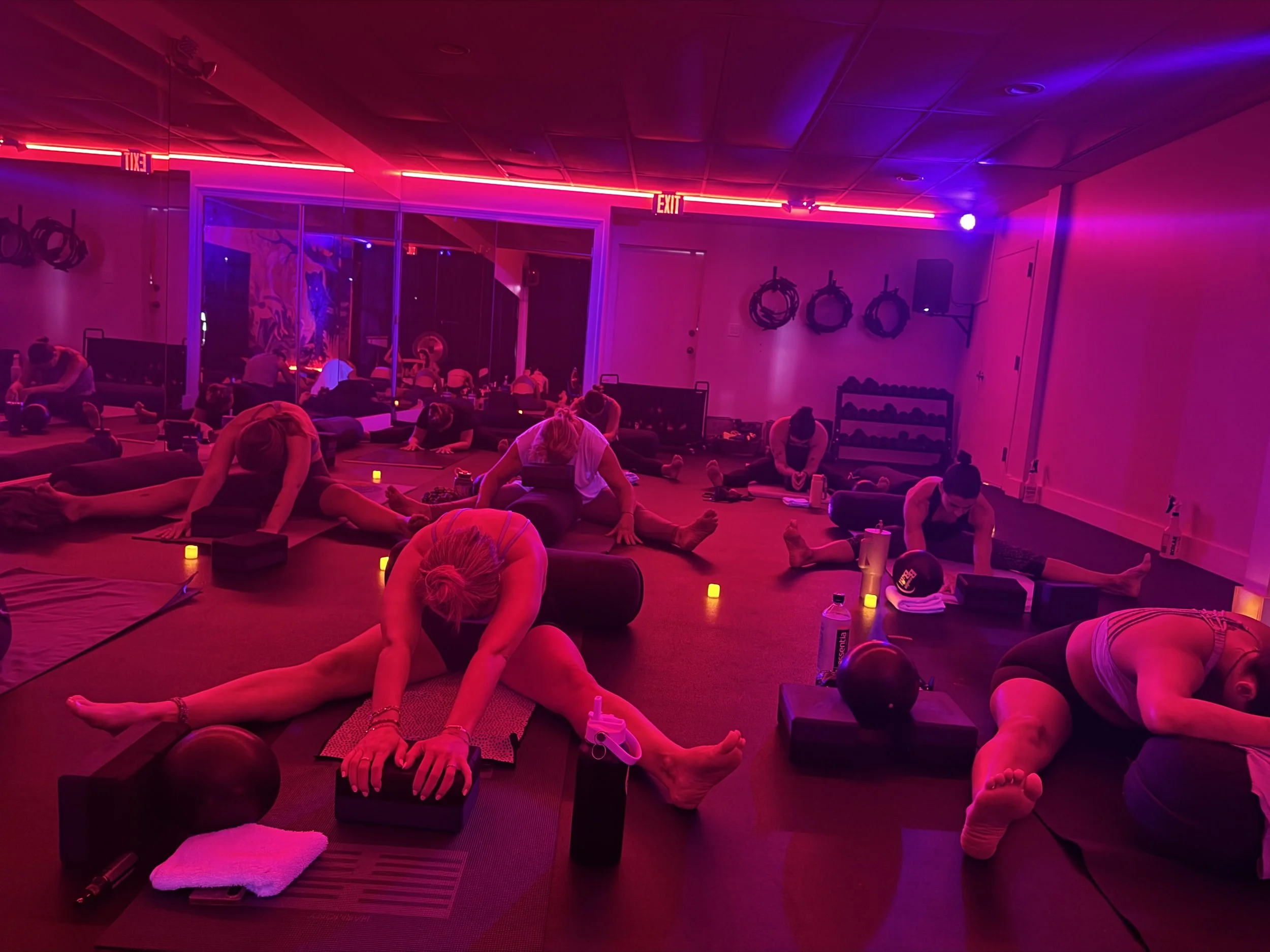
At minute 46, shift into down-regulation. Counter external hip rotation with floor postures like Half Pigeon (Eka Pada Rajakapotasana) or Seated Forward Fold (Paschimottanasana), which soothe the lower back and hamstrings. Wind down with Happy Baby and a supine spinal twist, releasing residual tension across the lateral hip and spine. By minute 54, settle into full stillness in Savasana, allowing the central nervous system to shift from sympathetic exertion into parasympathetic repair.
Essential Strategies for Flawless Execution and Timing
One of the most common pitfalls when leading or practicing a home flow is running out of time. Teachers often linger in the warm-up for 15 minutes, realize at minute 35 that they haven't started their standing balance series, and end up cutting the cool-down or Savasana.
To maintain time discipline:
- Protect the end of class first: Mentally lock in your Savasana start time (minute 54). Everything prior must adapt to preserve that window.
- Trim from the middle: If you notice at minute 35 that you are behind schedule, do not rush the peak or skip the cool-down. Instead, drop the second repetition of a standing sequence or remove an extra vinyasa transition.
- Use cue economy: Long, wordy descriptions slow down your movement pace. Use direct, action-oriented cues linked to breath (e.g., "Inhale, sweep the arms high; exhale, hinge and fold").
- Stick to a sequence framework: Rely on balanced templates so you spend less mental energy calculating time and more energy refining alignment and breath awareness.
Multi-Level Modifications for Your 60 Minute Vinyasa Flow
A well-crafted vinyasa flow meets the body where it is on any given day. Props are essential tools for maintaining structural integrity and staying within a comfortable, pain-free range of motion.
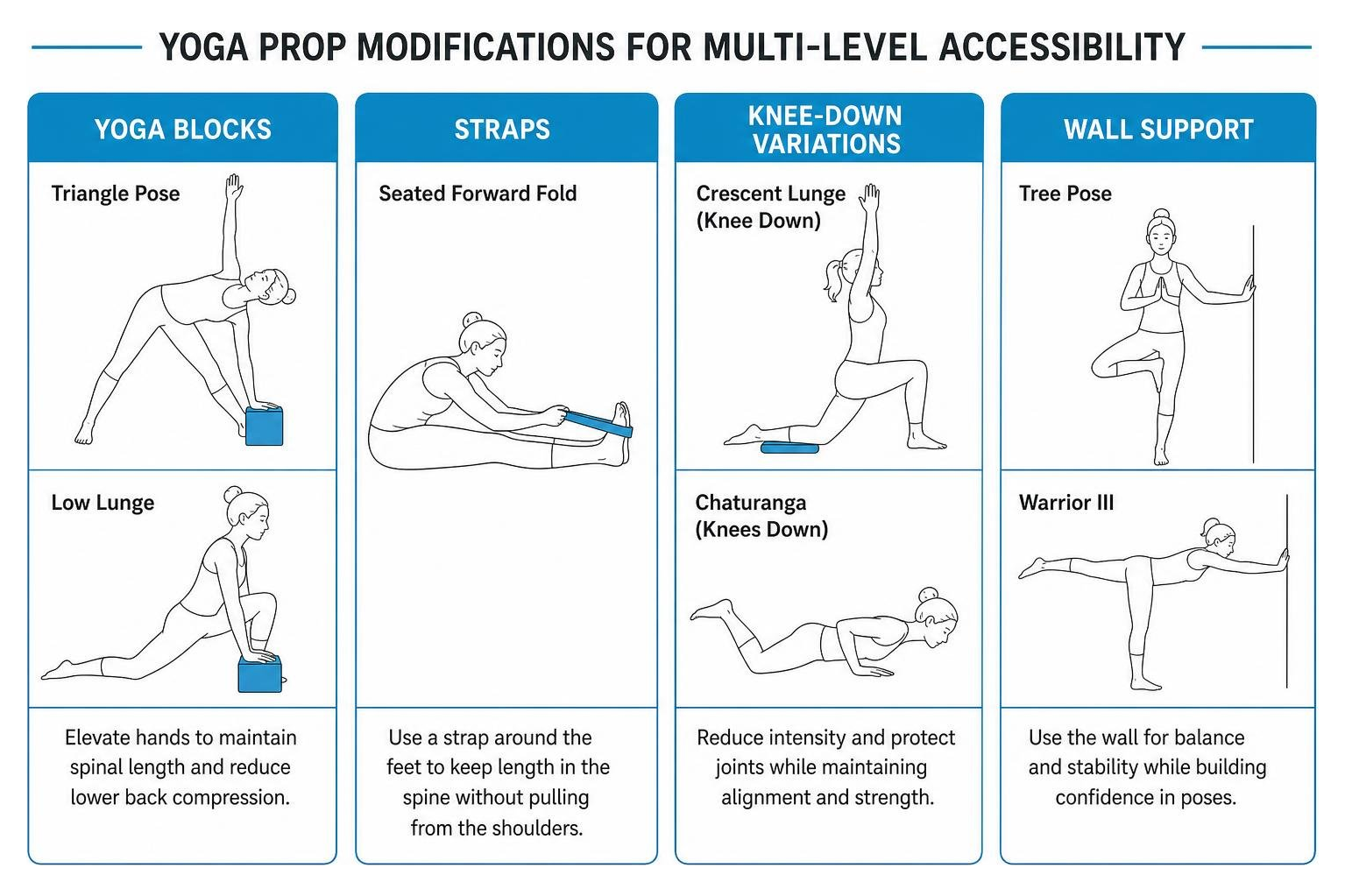
- Yoga Blocks: Place blocks under hands in Half Moon Pose or Triangle Pose to elevate the floor, preventing spinal rounding and over-stretching the hamstrings. In lunges, blocks beneath the palms reduce compression in the lower back.
- Straps: Use a strap around the feet in Seated Forward Fold to maintain length across the lumbar spine rather than pulling from the shoulders.
- Knee-Down Variations: Dropping the back knee in Crescent Lunge or lowering the knees during Chaturanga preserves shoulder stability and relieves pressure on the hip flexors.
- Wall Support: Practice standing balances like Tree Pose or Warrior III with a hand against a wall to build stability without fear of falling.
Practicing at home is a powerful way to build self-reliance, but moving in a room with hands-on guidance and shared energy brings fresh inspiration to your mat. Joining our in-studio classes offers a balanced environment where you can refine your technique, explore new variations, and deepen your practice with the support of experienced teachers.
Frequently Asked Questions About 60-Minute Vinyasa Sequencing
How many total poses should be included in a 60-minute class?
A standard class features roughly 30 to 50 pose positions when counting both the right and left sides, transitional downward dogs, and sun salutation repetitions. Rather than tracking raw pose numbers, focus on maintaining a steady breath-to-movement ratio and honoring the time blocks of the class arc.
What should you do if you run out of time before the peak pose?
If you are running behind schedule, simplify the sequence immediately. Never eliminate Savasana or compress your cool-down stretches into sixty seconds. Drop optional standing variations, reduce the hold times in your final standing series, and offer the peak pose as a simplified, single-attempt posture before transitioning directly to the floor.
How long should Savasana last in a one-hour flow?
Savasana should always receive a minimum of 5 to 7 full minutes in a 60-minute class. This period of stillness is essential for physiological down-regulation, allowing heart rate and blood pressure to return to baseline while integrating the physical work of the practice.
Conclusion
Mastering an hour-long flow at home gives you full ownership of your physical and mental well-being. By honoring the classic arc—grounding your awareness, generating heat through intelligent sun salutations, exploring your peak, and unwinding with floor stretches—you create a safe, sustainable practice that builds strength without causing burnout.
While a solid home routine is an invaluable anchor, combining solo practice with studio community and dedicated recovery helps your body thrive. At Agni Miami, we blend high-energy movement with deep restorative care. Whether you want to complement your vinyasa practice with heated flows, explore strength-building classes, or unwind with contrast therapy in our infrared sauna and cold plunge, you will find an encouraging space designed to support your wellness journey. Experience the balance of movement and recovery by visiting Agni Miami and taking your practice to the next level.